Why People Think the Sun Is Fire
For thousands of years, humans looked up and saw the Sun blazing in the sky—bright, hot, and glowing with fiery yellow-orange light. Naturally, the closest comparison was fire. Just as flames consume wood or oil, it seemed the Sun must be burning something to keep shining.
This image of a “giant cosmic fireball” stuck, because fire was the most familiar experience of heat and light available to early civilizations.
The Science of Fire vs. the Science of the Sun
-
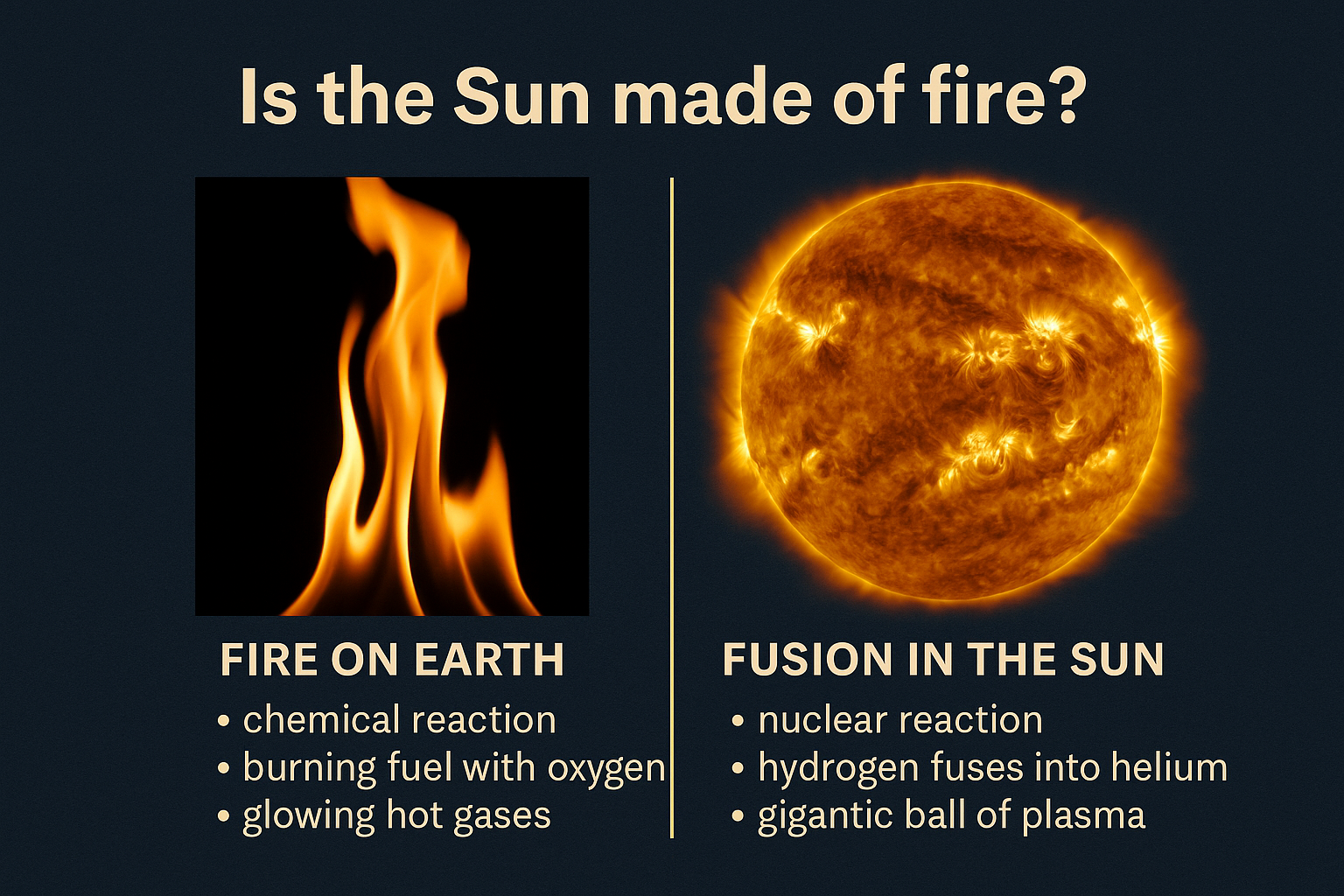
Fire on Earth: A chemical reaction. It happens when fuel (like wood or gas) reacts with oxygen, releasing light and heat.
-
The Sun’s Energy: Not chemical burning at all, but nuclear fusion. Deep in its core, enormous pressure and heat force hydrogen atoms to fuse into helium, releasing vast amounts of energy in the process.
So the Sun isn’t “burning” like a candle or a campfire—it’s powered by fusion, the same process that humans attempt to recreate in experimental nuclear reactors on Earth.
A Giant Ball of Plasma
The Sun is made not of flames, but of plasma—a state of matter where gas becomes so hot that electrons are stripped from atoms. Plasma glows intensely and moves in turbulent currents, creating the fiery appearance we see from Earth.
What looks like flames leaping on the Sun’s surface are actually plasma loops and eruptions caused by powerful magnetic fields.
Why the Fire Myth Persists
The idea of the Sun being “made of fire” survives because:
-
It looks like fire—yellow, glowing, radiating heat.
-
Fire was the closest analogy early humans had to explain it.
-
Saying “the Sun is fire” is simple, while nuclear fusion is complex.
But in reality, the Sun is far more powerful than any fire—its energy comes from the same process that powers the stars across the universe.
✨ Final Thought:
The Sun isn’t burning like a flame—it’s fusing like a star. Understanding this difference shows just how extraordinary it is: not a fire in the sky, but a nuclear furnace that makes life on Earth possible.