Parallel Sun Rays: Proof the Sun Is Local, Not 93 Million Miles Away
admin
Author
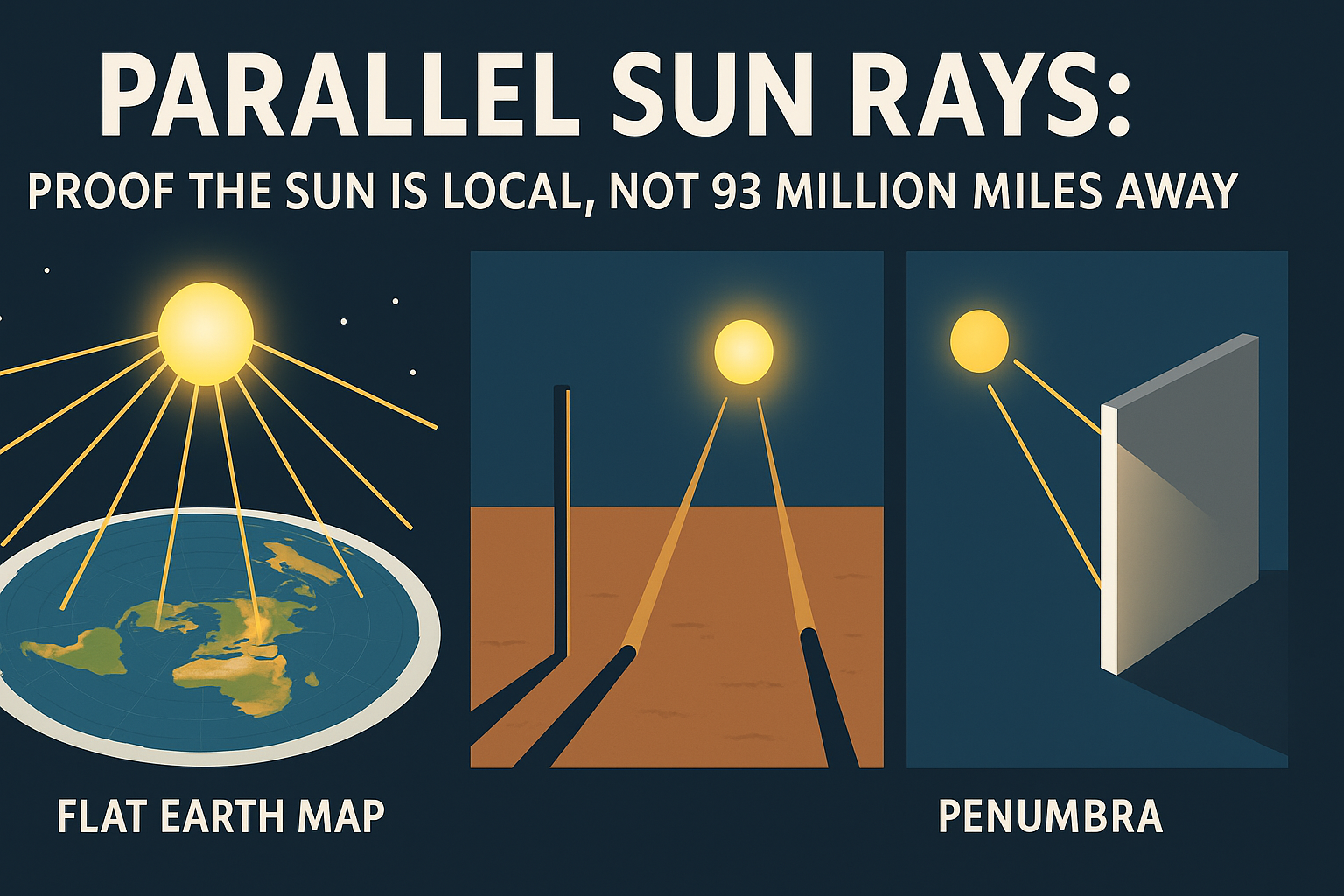
Parallel Sun Rays: Proof the Sun Is Local, Not 93 Million Miles Away
The widely accepted scientific consensus holds that the Sun is approximately 93 million miles (about 150 million kilometers) away from Earth. This distance is foundational to modern astronomy, physics, and our understanding of the solar system. However, some alternative viewpoints challenge this notion, often citing observations related to the nature of sunlight—specifically, the behavior of sun rays—as evidence that the Sun might be much closer, perhaps even local to our environment.
In this article, we will explore the concept of parallel sun rays, analyze the arguments presented by proponents of a local Sun theory, and critically evaluate the evidence to understand whether the Sun’s rays truly prove that the Sun is nearby or if conventional science provides a more accurate explanation.
—
What Are Parallel Sun Rays?
Sun rays, or crepuscular rays, are the beams of sunlight that appear to radiate from the Sun during sunrise or sunset, often seen streaming through gaps in clouds or between objects. These rays seem to fan out across the sky, creating beautiful visual effects.
Interestingly, these rays appear to diverge from a single point—the Sun—and spread outwards. However, scientific understanding explains this as a perspective effect, much like railroad tracks that seem to converge in the distance but are parallel in reality.
Why Do Sun Rays Appear Parallel?
Despite appearances, the rays of sunlight reaching Earth are essentially parallel because the Sun is incredibly far away. The Sun’s diameter is about 864,000 miles (1.39 million kilometers), yet it is so distant that the light waves reaching us are nearly parallel. This is why shadows cast by sunlight are sharp and consistent in direction over large distances.
—
The Argument for a Local Sun Based on Parallel Rays
Some alternative thinkers argue that the phenomenon of parallel sun rays is proof that the Sun is not 93 million miles away but rather local—close enough for its rays to appear parallel without the need for a massive distance.
Here are the key points typically made in this argument:
1. Parallel rays imply proximity: If sun rays appear parallel, the Sun must be close, because an object 93 million miles away should produce noticeably divergent rays.
2. Sunbeam angles: Observers note that sun rays penetrate through small openings and maintain a consistent width over long distances, which they argue would not be possible if the Sun were extremely distant.
3. Visible angular size: The apparent size of the Sun in the sky (about 0.5 degrees) is constant regardless of atmospheric conditions. Proponents claim that if the Sun were very far, its rays would show more divergence or dispersal.
—
Understanding Perspective: Why Parallel Rays Don’t Prove a Local Sun
To critically evaluate these claims, it’s important to understand perspective geometry and how light behaves over vast distances.
Perspective Explains the Parallel Appearance
The rays of sunlight are indeed parallel, but this does not mean the Sun is nearby. Because the Sun is so far away, the angle between rays is minuscule—on the order of less than 0.5 degrees, the Sun’s angular diameter. Over the scale of the Earth (thousands of miles), these rays appear perfectly parallel.
Imagine standing on a long straight road with telephone poles on either side. Even though the poles are parallel, they seem to converge at a vanishing point on the horizon. Similarly, sun rays seem to radiate outward but are actually nearly parallel lines of light converging at the Sun’s position.
Sunbeams Through Openings Are Subject to Optical Effects
When sunlight streams through gaps in clouds or tree branches, the sunbeams you see are shaped by:
– Scattering of light by atmospheric dust and particles: This causes the beams to be visible.
– The shape and size of the openings: Narrow slits create more defined beams.
– Perspective: The beams appear to diverge or converge based on the observer’s viewpoint.
These optical effects do not necessitate a local Sun.
—
The Science Behind Sunlight and Distance
Measuring the Distance to the Sun
The distance to the Sun has been measured with high precision using numerous methods:
– Radar reflections from planets: Timing signals bounced off Venus and Mercury gives direct measurements.
– Parallax measurements: Observing the transit of Venus across the Sun relative to Earth’s position in orbit.
– Space missions and satellites: GPS and solar probes use precise instruments to measure solar distance accurately.
All these measurements consistently confirm the Sun’s distance at about 93 million miles.
Why the Sun’s Distance Matters
The enormous distance explains various phenomena:
– Why the Sun appears as a disk rather than a point light.
– How solar radiation spreads out, affecting temperature and climate.
– Why sunlight is effectively parallel, ensuring sharp shadows and consistent illumination.
—
Addressing Common Misconceptions
Misconception: Parallel rays cannot come from a distant source
This is a misunderstanding of geometry. Parallel rays can and do come from distant sources because the rays emitted from the Sun spread out so little over the vast distance.
Misconception: Sunbeam width consistency means proximity
The width of sunbeams is influenced by atmospheric conditions and the size of openings, not by the distance to the Sun.
Misconception: The Sun looks small, so it must be close
The Sun’s apparent size matches its actual size combined with its distance. If it were close, it would appear much larger and brighter, which it does not.
—
Why the Local Sun Theory Does Not Hold Up
While questioning mainstream views is a healthy part of science, the local Sun theory based on parallel sun rays falls short due to:
– Lack of empirical evidence: Measurements from radar, parallax, and spacecraft contradict the local Sun hypothesis.
– Misinterpretation of optical phenomena: Perspective and atmospheric effects explain the appearance of sun rays.
– Consistency of solar observations: The Sun’s size, brightness, and position align perfectly with a distant star rather than a local light.
—
Conclusion
The mesmerizing parallel rays of the Sun are a beautiful optical phenomenon that invites curiosity about our nearest star. However, these rays do not provide proof that the Sun is local or nearby. Instead, they illustrate the fascinating interplay of light, perspective, and atmospheric conditions.
Scientific methods, observations, and measurements robustly support the fact that the Sun is approximately 93 million miles away from Earth. The parallel nature of sun rays is entirely consistent with this immense distance and the physics of light propagation.
Understanding these principles helps us appreciate the Sun’s true scale and distance while dispelling myths that arise from misinterpreted observations. The Sun remains a distant, colossal star whose rays, parallel and steady, sustain life on Earth from afar.
—
Keywords: parallel sun rays, local Sun theory, distance to the Sun, sunbeam optics, sun rays proof, Sun 93 million miles away, sunlight parallelism, solar distance measurement, atmospheric light scattering, sun rays perspective